Can a landlord deny you an apartment because of a criminal record?
In many places, a private landlord can consider criminal history. No federal statute flatly prohibits criminal background screening for private rentals. But “can consider” is not the same as “can do anything.” Three bodies of law set limits:
- The Fair Housing Act, which bans housing discrimination based on protected traits.
- The Fair Credit Reporting Act (FCRA), which controls what screening companies may report and what landlords must tell you.
- State and local fair chance housing laws, which in some places restrict what criminal history a landlord may consider at all.
What does the Fair Housing Act say about criminal records?
The Fair Housing Act makes it unlawful to refuse to rent, or to otherwise make housing unavailable, because of race, color, religion, sex, familial status, national origin, or disability (42 U.S.C. § 3604). A criminal record is not itself a protected trait.
Criminal record screening can still raise Fair Housing Act issues in two ways:
- Unequal treatment. A landlord who rejects an applicant of one race for a criminal record but accepts an applicant of another race with a comparable record is treating people differently because of race.
- Discriminatory effect. In 2015, the U.S. Supreme Court held in Texas Department of Housing and Community Affairs v. Inclusive Communities Project that disparate-impact claims, which challenge policies with an unjustified discriminatory effect, can be brought under the Fair Housing Act.
The Act also has a specific carve-out: it does not prohibit conduct against a person because the person has been convicted of the illegal manufacture or distribution of a controlled substance (42 U.S.C. § 3607(b)(4)).
What did HUD’s 2016 guidance say, and is it still in effect?
On April 4, 2016, HUD’s Office of General Counsel issued guidance on how the Fair Housing Act applies to criminal records in housing. Among other things, it said:
- A policy of excluding people because of arrests that did not lead to a conviction cannot meet the housing provider’s burden of showing the policy is necessary to achieve a substantial, legitimate, nondiscriminatory interest.
- A blanket ban on anyone with any conviction, regardless of when it happened, what it involved, or what the person has done since, would not meet that burden.
- An individualized assessment that considers mitigating information, such as the facts of the offense, the person’s age at the time, tenant history, and rehabilitation, is likely to have a less discriminatory effect than categorical exclusions.
That guidance has been withdrawn. A HUD notice published in the Federal Register on July 17, 2026 lists the April 4, 2016 guidance among Office of General Counsel documents withdrawn effective September 25, 2025, and says withdrawn documents should not be relied on as authoritative. Separately, HUD issued Notice PIH 2025-26 / H 2025-05, which rescinded its 2015 notice on the use of arrest records in public and HUD-assisted housing.
What this means in practice: HUD’s 2016 views are no longer official agency guidance, but the Fair Housing Act and the Supreme Court’s 2015 decision recognizing disparate-impact claims have not changed. Courts decide these cases. If you think a criminal history policy was applied to you unequally, or excludes far more people of one race than necessary, a fair housing lawyer or local fair housing agency can evaluate it.
What does the FCRA protect when a landlord checks your criminal record?
The FCRA does not stop a landlord from considering an accurate conviction. It does control the report itself and the notice you receive:
- Time limits. Arrest records and civil cases generally cannot be reported once they are more than seven years old (or until the statute of limitations expires, if longer). Convictions are not subject to that federal limit (15 U.S.C. § 1681c).
- Accuracy. A screening company must use reasonable procedures to assure the maximum possible accuracy of what it reports. A record that belongs to someone else, a dismissed case shown as a conviction, or a sealed record can raise accuracy problems.
- Adverse action notice. If a landlord denies you based in whole or in part on a screening report, it generally must tell you, name the screening company, and explain your right to a free copy within 60 days and your right to dispute (15 U.S.C. § 1681m(a)).
If the record on your report is wrong, see our guide on what to do after being denied an apartment because of a background check, and our page on tenant screening report errors.
Do state and local fair chance housing laws protect you?
In some places, yes, and these laws often go further than federal law. They vary widely, so check the rules where the property is located. Two examples from areas where we have offices:
Cook County, Illinois (including Chicago). The county’s Just Housing Amendment took effect January 1, 2020. According to the Cook County Commission on Human Rights, landlords may not consider arrests that did not lead to a conviction, may not consider convictions more than three years old, must first prequalify applicants on other criteria before running a criminal background check, and must conduct an individualized assessment before denying based on a conviction. Denials based on a conviction must be in writing.
California. Regulations that took effect January 1, 2020 restrict criminal history screening under the state’s Fair Employment and Housing Act. The California Civil Rights Department says housing providers may not seek or consider arrests that did not lead to a conviction, infractions, convictions that were sealed, dismissed, or expunged, or most juvenile matters, and that a denial must be based on a “directly-related conviction.” The CRD also says housing providers may not advertise blanket bans like “No Felons.”
Other cities and states have adopted their own versions. Some limit how far back a landlord can look, some require the landlord to consider other qualifications first, and some require a written explanation and a chance to respond.
What should you do if you were denied because of a criminal record?
- Ask for the denial and the adverse action notice in writing.
- Request your free report from the screening company within 60 days.
- Check whether the record is yours, whether the outcome is right, and whether it is too old to report.
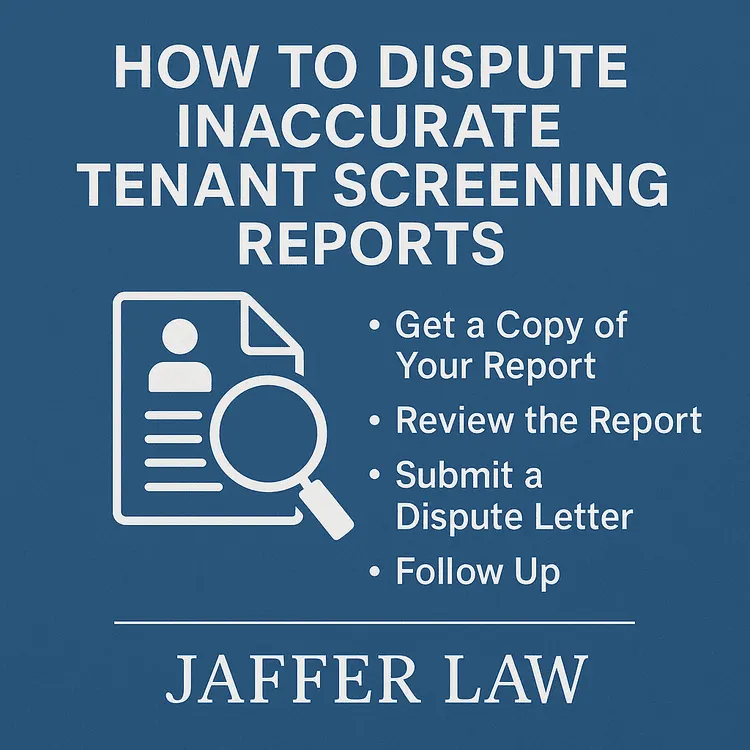
- Dispute anything inaccurate with the screening company. Our guide to disputing a tenant screening report explains how.
- If the record is accurate, ask the landlord whether it will consider mitigating information, and check your state and local fair chance rules.
When to talk to an FCRA attorney
If a screening report showed a criminal record that is not yours, was sealed or dismissed, or was too old to report, and it cost you an apartment, talk to a lawyer. FCRA Attorneys offers a free case review, and you pay no fee unless we win. See the areas we serve.
Time limits apply. Under 15 U.S.C. § 1681p, an FCRA lawsuit generally must be filed within 2 years after you discover the violation, and no later than 5 years after the violation occurred.
Frequently asked questions
Can a landlord deny me an apartment because of a criminal record?
Often, yes. No federal law flatly bans criminal background screening in private housing. But the Fair Housing Act prohibits policies that discriminate based on race, national origin and other protected traits, including some policies with an unjustified discriminatory effect, and several states and cities restrict criminal history screening further.
Is HUD's 2016 criminal records guidance still in effect?
No. HUD's Office of General Counsel guidance from April 4, 2016 on applying Fair Housing Act standards to criminal records was withdrawn effective September 25, 2025, according to a HUD notice published in the Federal Register. The Fair Housing Act itself has not changed.
Can a landlord deny me for an arrest that did not lead to a conviction?
It depends on where you live. Some state and local laws, including California's regulations and Cook County, Illinois's Just Housing Amendment, prohibit landlords from considering arrests that did not result in conviction. Under the FCRA, arrest records generally cannot be reported once they are more than seven years old.
What if the criminal record on my screening report is not mine?
That is an accuracy problem under the Fair Credit Reporting Act. Request your report from the screening company, dispute the error in writing with proof, and keep records. A screening company must use reasonable procedures to assure maximum possible accuracy and must reasonably reinvestigate disputes.
Sources
- Federal Register: HUD Notice of the Withdrawal of OGC Guidance Documents (July 17, 2026)
- HUD Office of General Counsel guidance on criminal records and the Fair Housing Act (April 4, 2016, archived; withdrawn)
- HUD Notice PIH 2025-26 / H 2025-05 (rescinding 2015 arrest-records notice for HUD-assisted housing)
- 42 U.S.C. § 3604 – Discrimination in the sale or rental of housing
- 42 U.S.C. § 3607 – Religious organization or private club exemption (drug conviction provision)
- Texas Dept. of Housing and Community Affairs v. Inclusive Communities Project, 576 U.S. 519 (2015)
- Cook County Commission on Human Rights: Just Housing Amendment
- California Civil Rights Department: Fair Housing and Criminal History FAQ
- 15 U.S.C. § 1681c – Requirements relating to information contained in consumer reports
- 15 U.S.C. § 1681m – Requirements on users of consumer reports
Updated November 2026. This page is general information, not legal advice.